
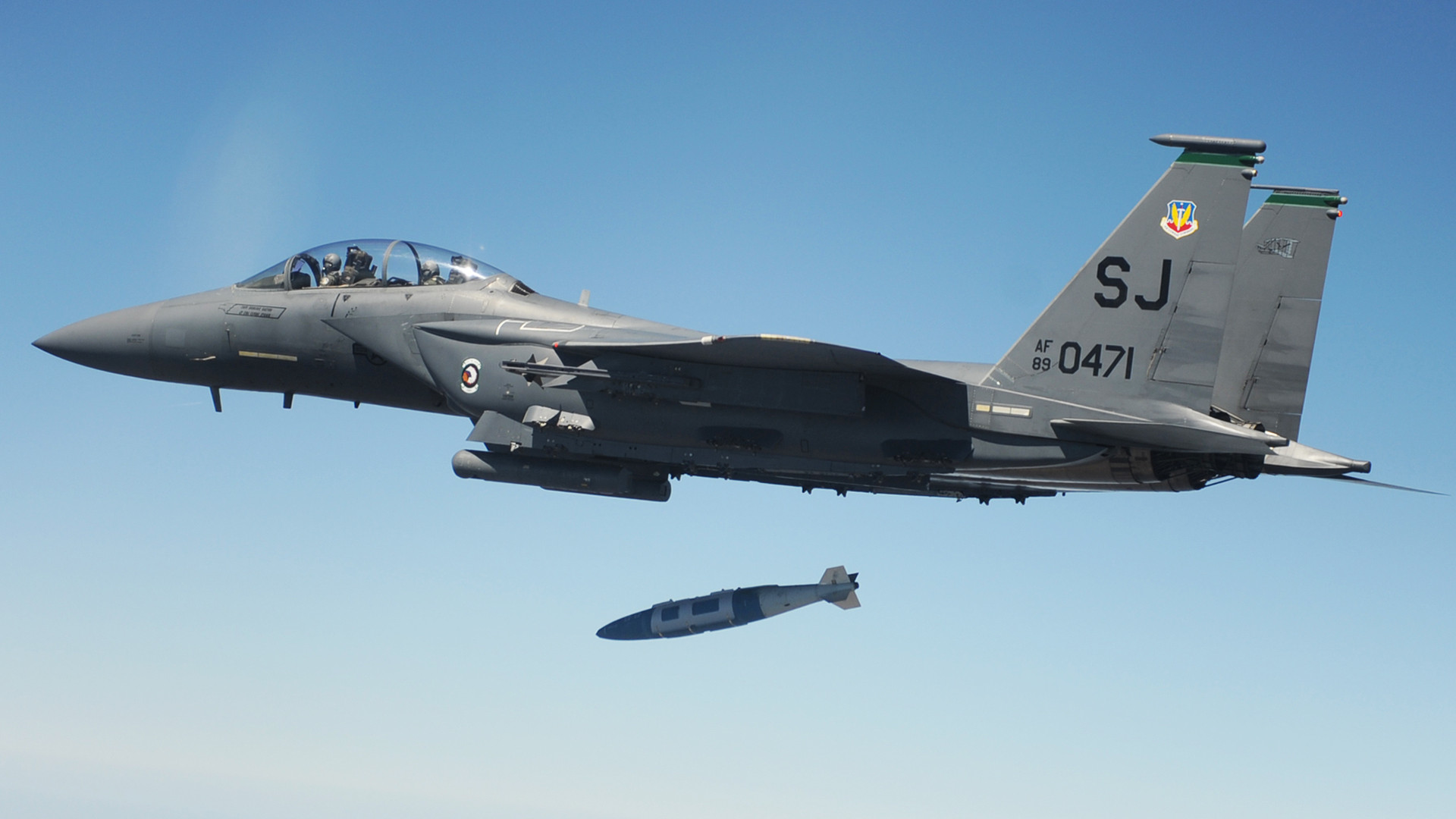
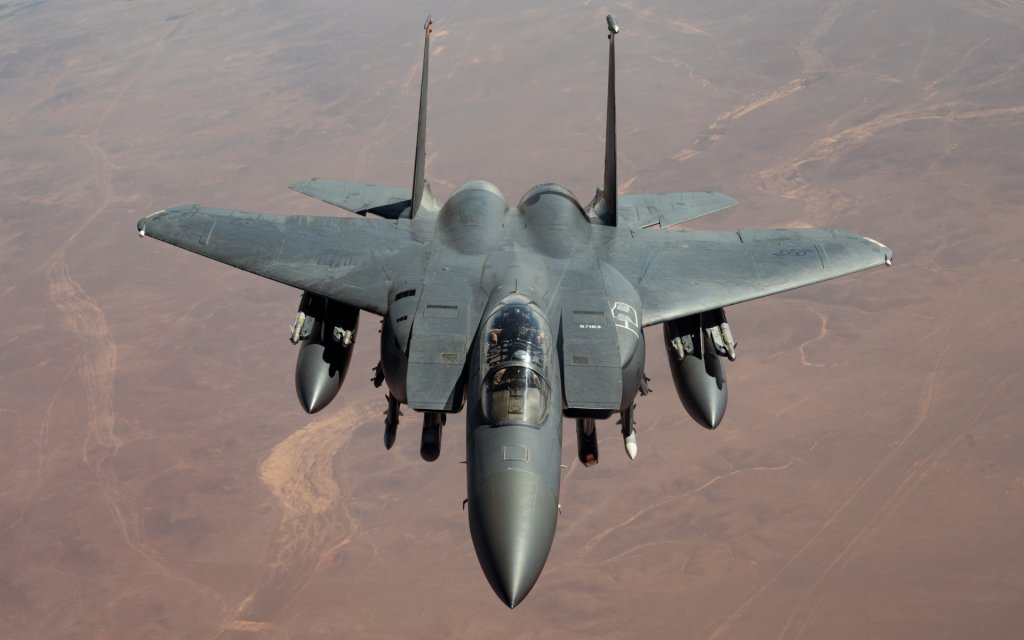
U.S. Air Force F-15E Strike Eagle crews attempted to take down long-range kamikaze drones with a Laser Joint Direct Attack Munition (LJDAM) precision-guided bomb after running out of missiles in the frantic midst of an all-out Iranian barrage aimed at Israel.
TWZ‘s Howard Altman had a chance to speak with Col. Timothy “Diesel” Causey, currently commander of the 494th Fighter Squadron, as well as Maj. Benjamin “Irish” Coffey, the unit’s chief of staff, after a panel discussion at the Air & Space Forces Association’s 2025 Air, Space, and Cyber Conference today.
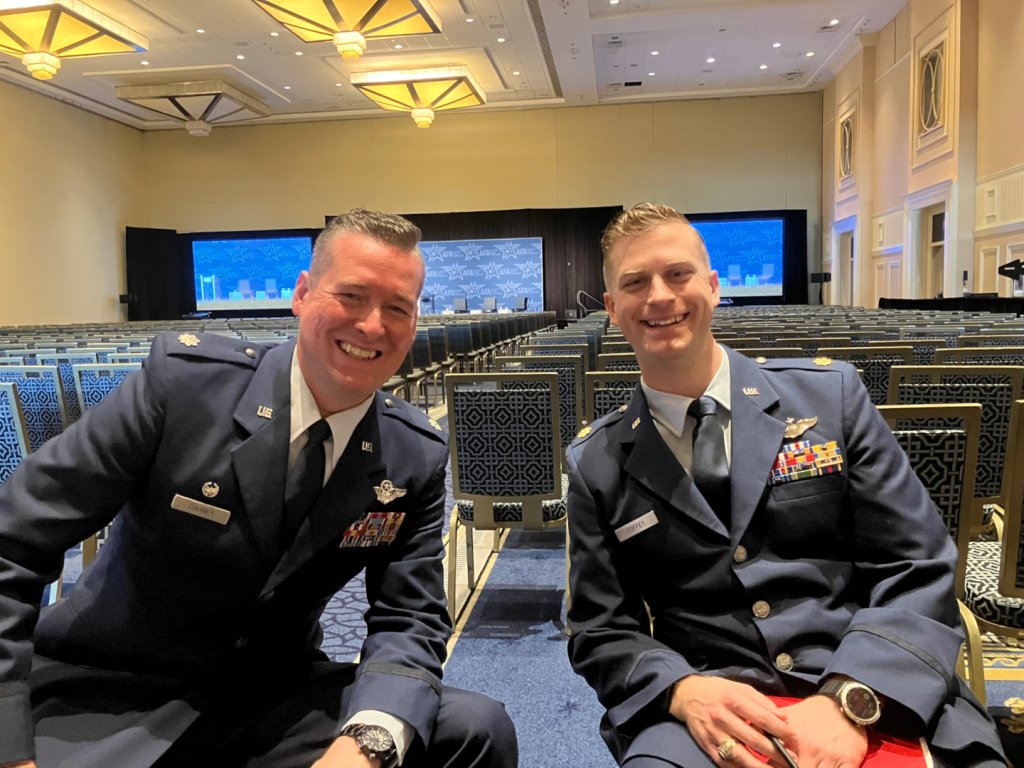
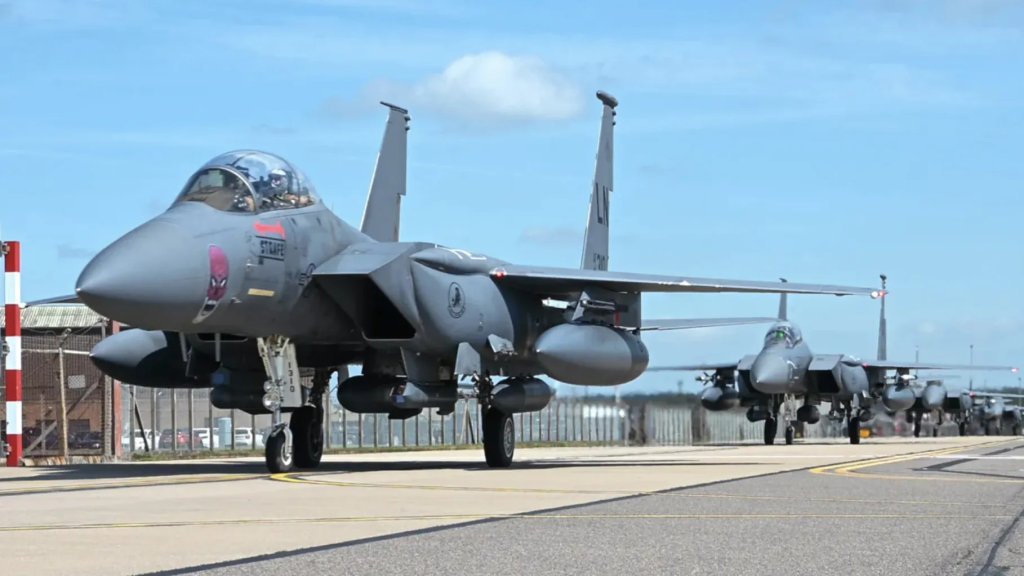
The 494th, based at RAF Lakenheath in the United Kingdom, deployed to the Middle East just weeks after the unprecedented terrorist attacks on Israel on October 7, 2023, and returned in May 2024. At that time, Causey was the unit’s director of operations.
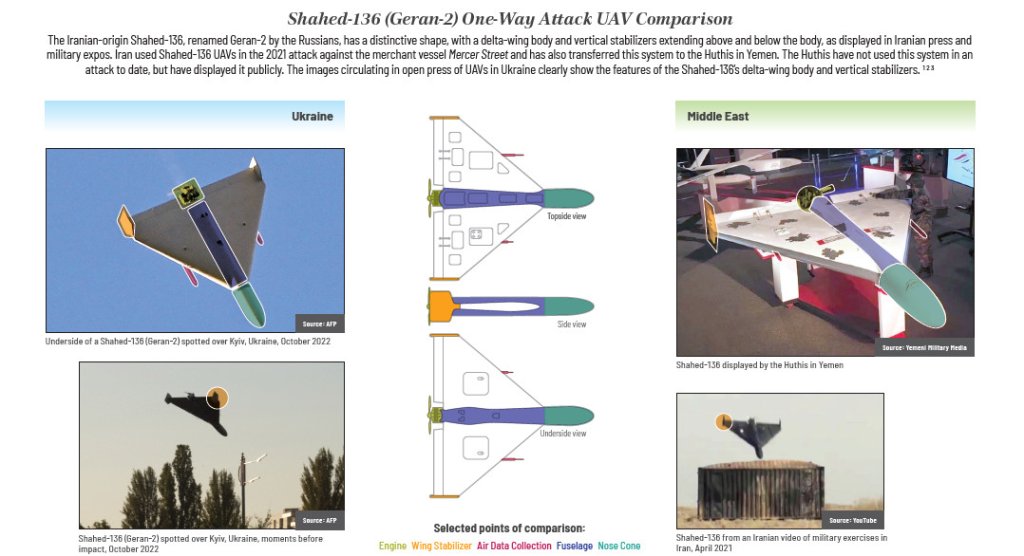
The squadron was heavily involved in the defense of Israel from an Iranian barrage on April 13, 2024. Iran launched scores of long-range kamikaze drones, including types nearly identical to the long-range one-way attack drones that Russia regularly launches at Ukraine, and which fly at light aircraft-like speeds. These are copies of Iran’s Shahed-136, many of which were used in the barrage on Israel. In addition to the drones, cruise missiles and throngs of ballistic missiles were also fired by Iran. It has already been established that there were so many threats in the air during the sustained and at times chaotic response that American combat jets had to land and rearm, as you can read more about here.
“We knew early on, as we start this process in December [2023] and January [2024], we’re shooting missiles. Sooner or later, somebody might find themselves in a situation where they’ve shot everything, and then what do I want them to do?” Causey explained. “It’s really important that our young guys aren’t out in a situation that somebody hasn’t thought about and assessed the risk for them.”
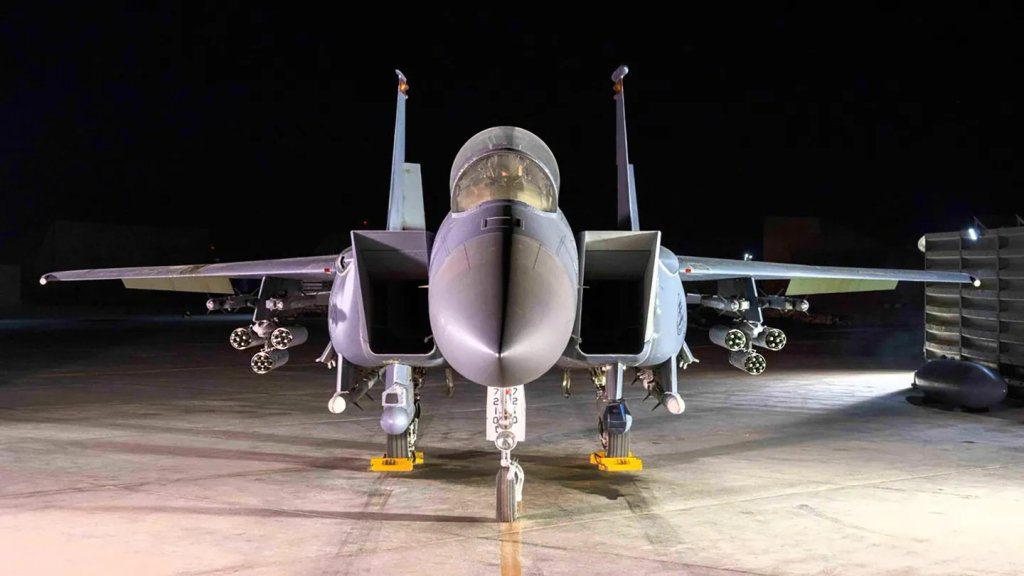
F-15Es can carry AIM-9 Sidewinders and AIM-120 Advanced Medium Range Air-to-Air Missiles (AMRAAM). The Strike Eagles can also carry a wide array of air-to-surface munitions, including various JDAM variants, and also have a built-in 20mm M61 Vulcan cannon. JDAMs come in 500, 1,000, and 2,000-pound classes, and are made by combining a kit that includes a new tail section containing a GPS-assisted guidance package with a standard guided ‘iron bomb.’ LJDAMs further add a laser seeker on the nose of the bomb, which allows them to engage moving targets. Standard JDAMs can only be employed against fixed target coordinates.
“And so we had conversations about, can we drop a bomb and laze it in? Can we use the gun, because we have a [sic] air-to-air gun,” he added. “Are there other non-kinetic ways [to down drones]?”
In an interview with CNN last year, Coffey had already disclosed a failed attempt to down an Iranian drone with F-15E’s Vulcan cannon during the attacks on Israel on April 13, 2024. Coffey was piloting the aircraft during that sortie, with Capt. Lacie “Sonic” Hester as the weapons systems officer (WSO, or ‘wizzo’) in the back seat.
During Operation Desert Storm in 1991, another F-15E actually scored an unusual air-to-air kill with a Paveway-series laser-guided bomb. The aircraft was targeting an Iraqi Mi-24 Hind attack helicopter on the ground, which began to take off after the weapon was released. The Strike Eagle’s WSO continued to lase the helicopter, and the bomb hit in mid-air.
“It was important for us to have that conversation, because then I can say to the squadron, you will not do this. If you find yourself in a situation and you need to drop a bomb, here are some things that we’ve thought about. Here are some techniques. This is how you are going to execute that process,” Causey continued. “And it might miss, which means you need to make sure that the area you’re dropping in is clear. There’s no civilians, there’s no vehicles, it’s better be the empty desert, or you’re going to just have to pass it on. Same thing for the gun.”
Eventually, Causey found himself in the position of deciding to try to knock an Iranian drone out of the sky with a precision-guided bomb.
“I’ve dropped a lot of JDAMs in my career. … I have dropped a JDAM on a moving vehicle in the past,” he said. “So now I’m thinking, okay, if I’m out of missiles, what am I going to do? Like, this thing, this drone, it’s near the ground, it’s low altitude, but it’s not on the ground. It’s moving a little bit faster than the vehicles we usually train against, but it’s not moving that much faster. And so, thinking through what changes do I need to make to my current procedures to do this?”
“We had shot all of our missiles. We’d gone all the way to the east. We turned around. We’d come back to the west. We’ve shot some more missiles. We find another drone,” he continued. “We just set it up, just like we would in attacking a car, and we made a few key changes to the actual procedure. And so we drop the bomb. Bomb comes off normal, normal [sic].”
“So, like the drones going this way. So we’ve swooped in, we’ve dropped a bomb, and then now we’re lazing it,” he added. “The bomb, it looks like it hits, big explosion. And I was like, hit. And then just out of this massive cloud, like in Star Wars, just here comes the drone, just right out of the cloud. And I was like, oh, miss.”
The decision was made to not attempt a second bombing run on the drone. Two other separate unsuccessful attempts were made to down Iranian drones using laser-guided bombs.
“They missed further than I did. Mine was the closest, just to be very clear,” Causey said.
“I ended up coordinating through command and control to stop doing it entirely, because my comfort with the level of risk acceptance for a miss now transcends outside of the tactical [realm],” Coffey said. “There’s strategic implications if something happens because of a missed bomb, so we end up just knocking it off until we can verify some ways to improve it.”
“I think it would be valid to test in a controlled environment on a range to verify, but that’s going to come with time, cost money,” he added.
Coffey and Causey both agreed that this could still be a tactic worth attempting in future mass drone attack scenarios where there aren’t any other options and there is a significant potential threat to friendly forces. Causey also highlighted the potential cost benefits of using something like an LJDAM instead of a traditional air-to-air missile. Though the unit cost of JDAM kits fluctuates regularly, historically they have been in the $20,000 to $30,000 range. The additional laser seeker on the LJDAM adds another 20,000 dollars or so. The standard ‘iron bomb’ to which the kits are added to create complete JDAMs raises the full price point by another few thousand dollars. The latest variants of the AIM-120 cost around $1 million apiece, while current-generation AIM-9Xs each have a price tag around $450,000.
Earlier this year, the Air Force rushed to integrate air-to-air optimized versions of the Advanced Precision Kill Weapon System II (APKWS II) 70mm laser-guided rocket onto the F-15E. Strike Eagles can now carry up to 42 APKWS II rockets on a single sortie, along with eight traditional air-to-air missiles, offering a huge boost in magazine depth for tackling drones, as well as subsonic cruise missiles.
Whether attempting to knock out hostile drones using laser-guided bombs becomes a more standardized tactic remains to be seen. It does underscore the ever-growing threat that uncrewed aerial systems present, especially when employed in large volumes to overwhelm defenders.
Under the challenging circumstances, “it was worth a try,” Causey said today in looking back on the events last year.
Contact the author: joe@twz.com