
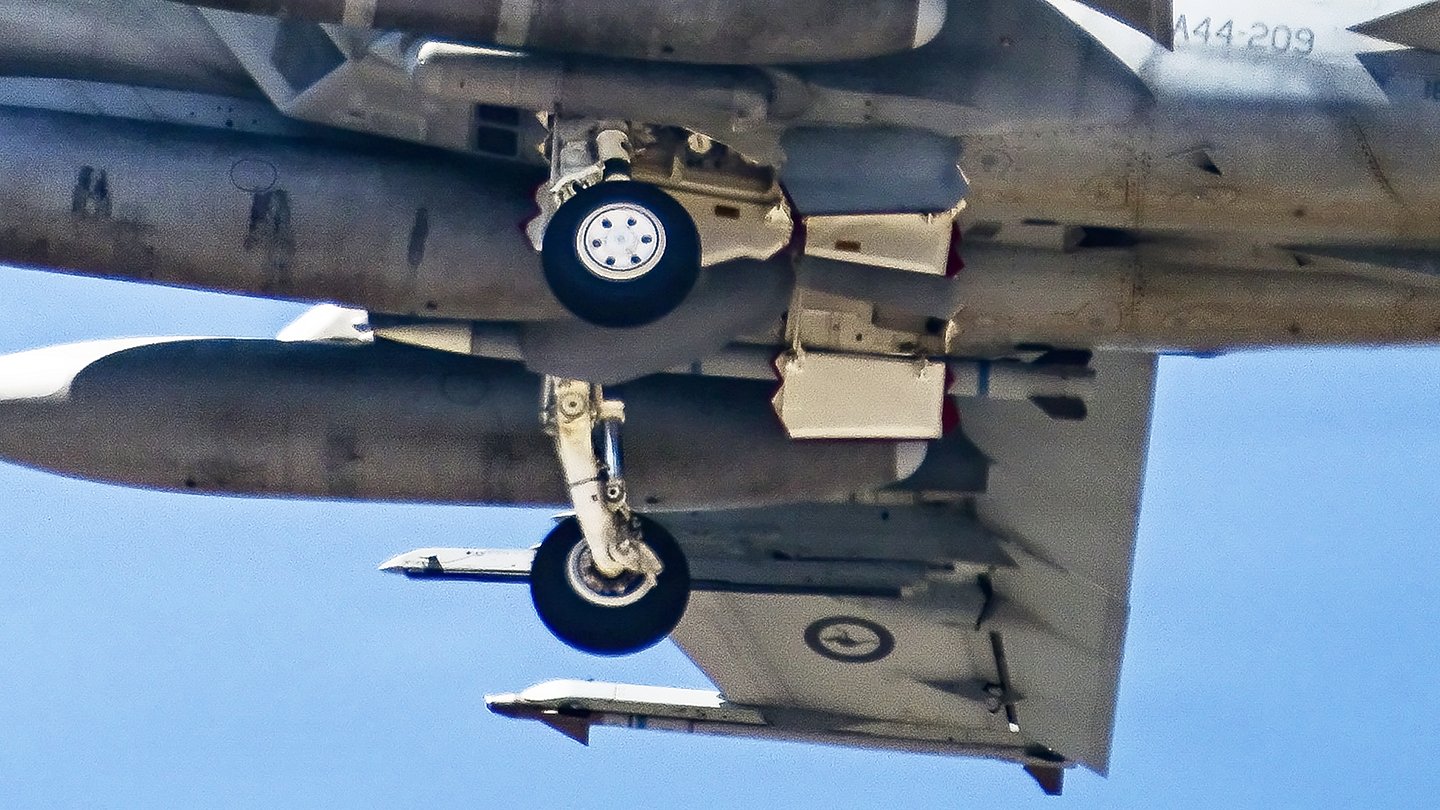
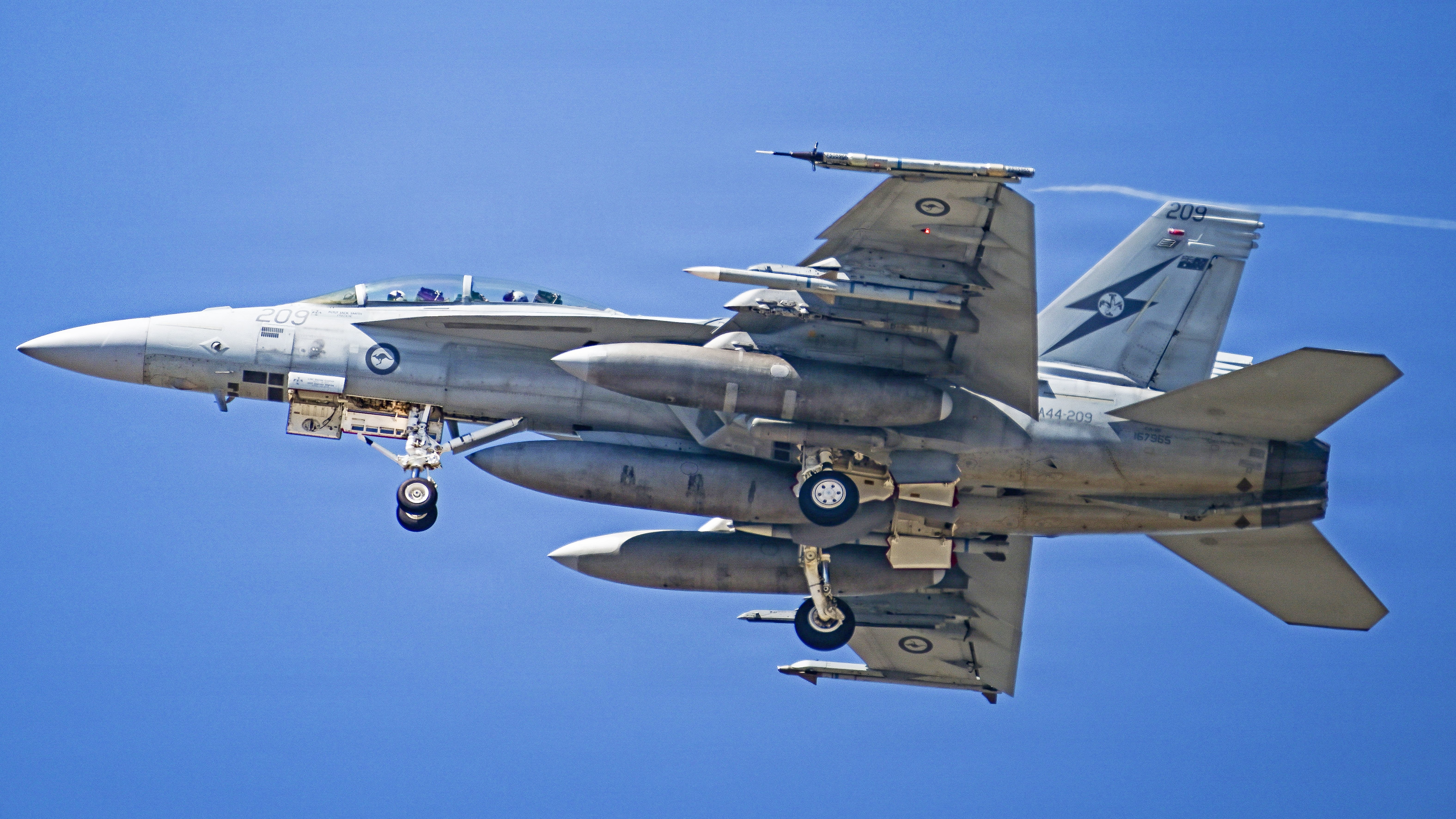
A Royal Australian Air Force F/A-18F Super Hornet has been photographed carrying an inert AIM-260 Joint Advanced Tactical Missile (JATM) during a major U.S. Navy test event in California. The development comes weeks after Australia announced that it would buy the new missile, with its Super Hornets being the first RAAF aircraft to receive it.
The photograph was released by the U.S. Navy and shows an RAAF F/A-18F assigned to No. 1 Squadron taking off from Naval Base Ventura County Point Mugu on September 11 during Gray Flag 2026. The loadout also includes a CATM-9X — the inert training variant of the AIM-9X — and a CATM-120, the inert training version of the AIM-120 AMRAAM, three external fuel tanks, an AN/ASQ-228 ATFLIR targeting pod, and a Tactical Combat Training System (TCTS) pod.
Gray Flag is the naval aviation test community’s flagship large-force test event, providing opportunities for large-scale integration of new capabilities across services, platforms, industry, and allied forces. Gray Flag 2026 was the largest edition of the exercise to date. According to the Navy, more than 3,000 personnel from over 150 organizations participated, flying more than 750 sorties and logging over 2,000 flight hours across hundreds of multi-domain test objectives.
Previous iterations of Gray Flag have been used to test new and still-developmental weapons in increasingly complex, operationally representative scenarios, including actual missile engagements against realistic targets. Making use of the sprawling Point Mugu Sea Range, the event has also become an important opportunity for working out how sensors, weapons, aircraft, and networks interact as part of larger kill chains and kill webs. A new, longer-range air-to-air missile is especially relevant when it comes to developing tactics, techniques, and procedures within a broader, networked air-combat architecture.
Beyond being the first apparent glimpse of an Australian JATM in any context, integration of the weapon onto Australia’s Super Hornet fleet has already progressed to the point of carrying the missile — in inert form — during a major U.S.-based test and integration exercise.
As TWZ reported in August, Australia is set to become the first country outside the United States to operate the AIM-260 following a roughly $480-million procurement through the U.S. Foreign Military Sales program. The Australian government said at the time that the missile would first be integrated onto the RAAF’s F/A-18F fleet, before being fielded on the F-35A and EA-18G Growler. Looking further ahead, the RAAF’s MQ-28 Ghost Bat collaborative combat aircraft (CCA) could also emerge as a candidate for integration with JATM.
Australia’s announcement did not provide a delivery schedule or specify when JATM would enter Australian service.
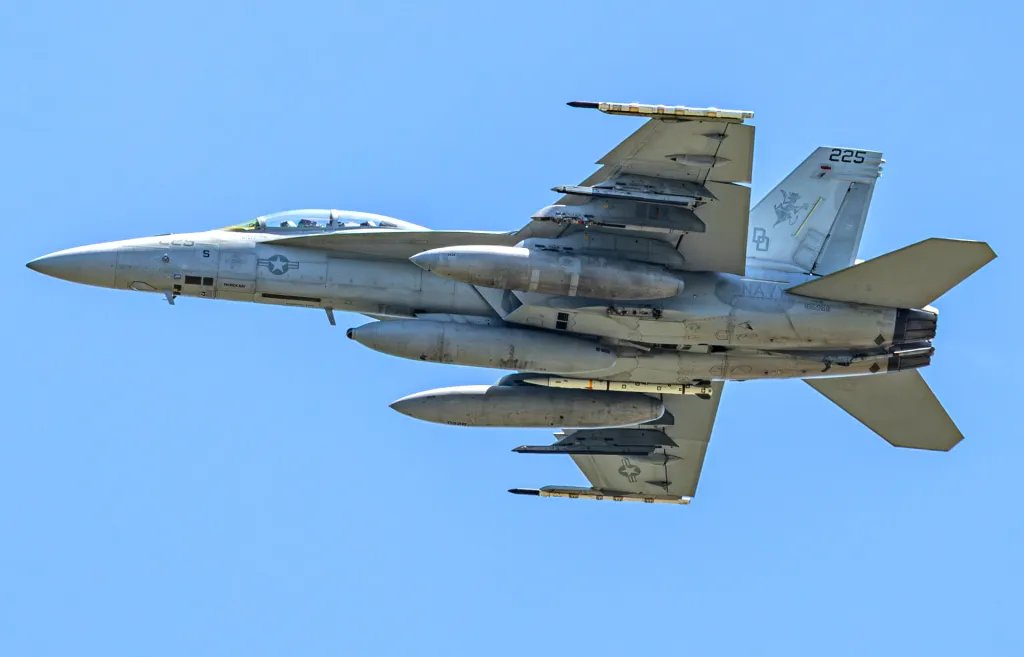
The overall proportions and external configuration of the AIM-260 were revealed when an example appeared on a U.S. Navy F/A-18F in May of this year. That aircraft, operated by Air Test and Evaluation Squadron 31 (VX-31), provided the first publicly known photographic view of the highly classified missile.
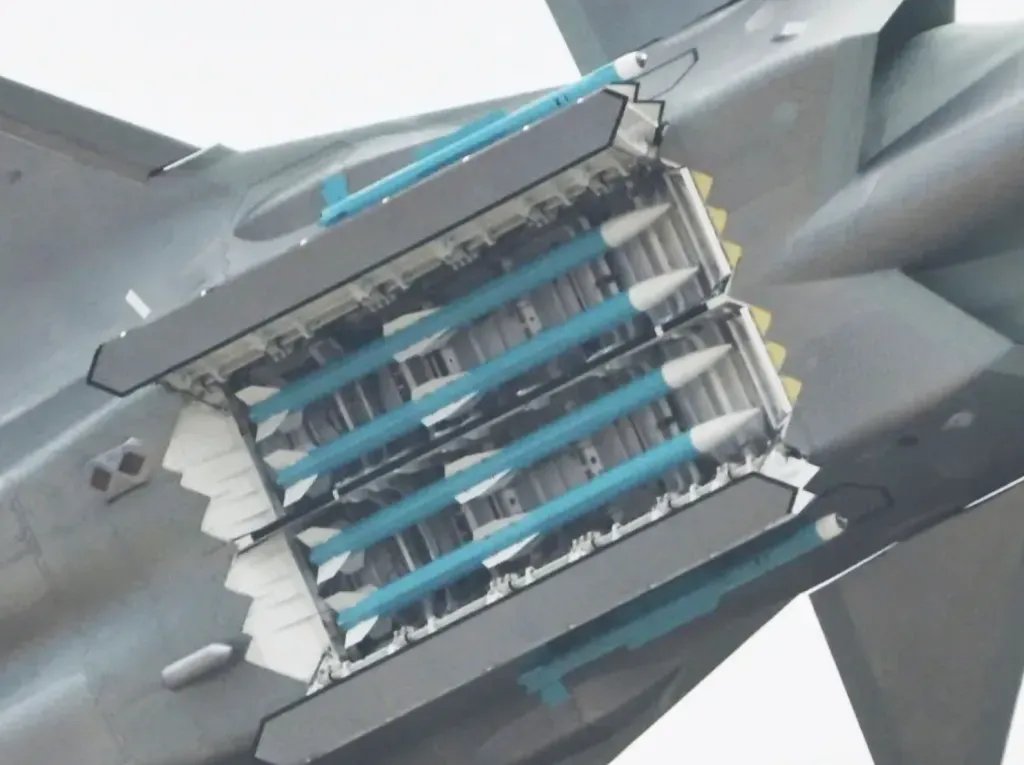
The AIM-260’s exact specifications remain classified. It is intended to provide substantially greater range than the AIM-120 AMRAAM while retaining a broadly similar form factor. That compact configuration is important because the missile is designed not only for external carriage but also for internal carriage by aircraft such as the F-22 and F-35.
The weapon has been developed as a response to the increasingly long-range air-to-air threat posed by China’s PL-15 and other advanced missiles. Official range figures have not been released, although previous reporting has pointed to an intended range of at least 120 miles and potentially considerably more.
The Australian procurement therefore represents an important expansion of the JATM program beyond the U.S. fleet.
The timing of the Point Mugu photograph is particularly interesting. Gray Flag is specifically intended to bring together large numbers of aircraft, weapons, sensors, networks, and other systems for demanding integration and test activities. An Australian Super Hornet carrying JATM at such an event would be entirely in line with the purpose of the exercise.
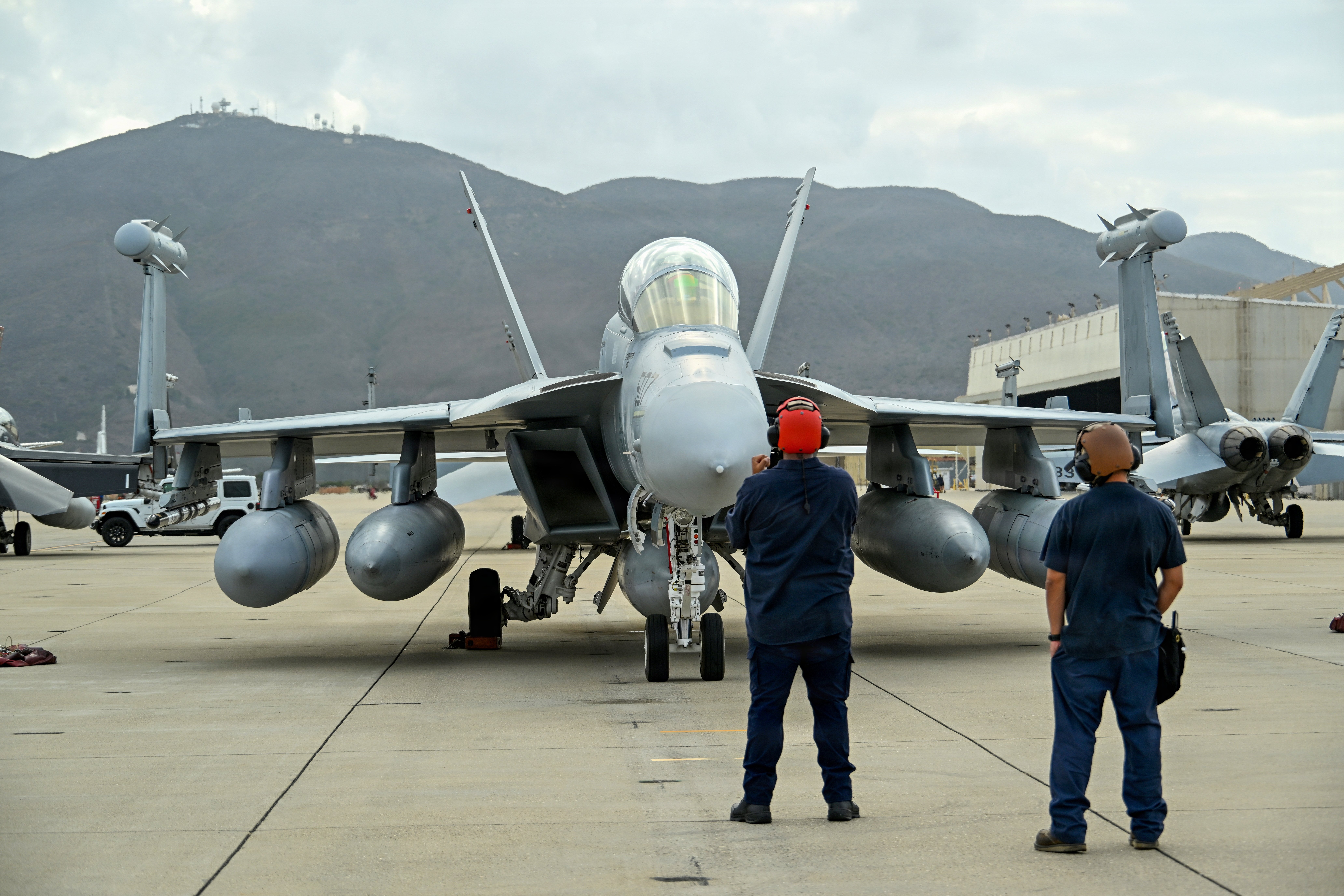
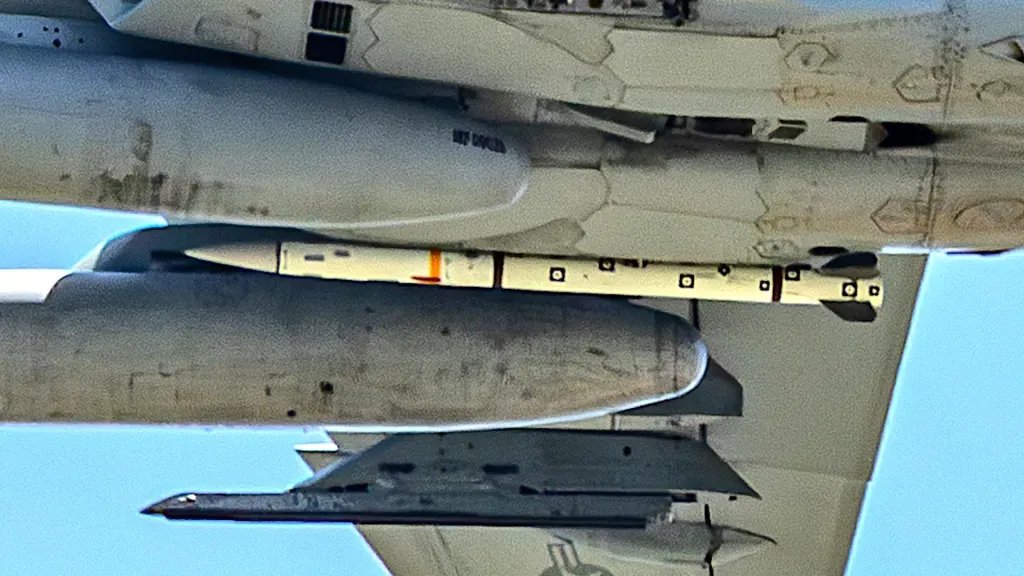
It is not clear, however, what role the missile was playing. The photograph does not establish whether it was an Australian-owned operational weapon, a U.S. test asset, or a missile being used for a particular integration activity. Blue bands on the missile body confirm that it’s a training missile with an inert rocket motor and/or warhead.
Public evidence of an Australian aircraft carrying the AIM-260 is another important milestone in the weapon’s transition from a closely guarded U.S. development program toward allied service.
It also underscores the most interoperability aspect of the Australian acquisition. Canberra is buying into a U.S. long-range air-to-air weapon program at a time when the Royal Australian Air Force and U.S. forces are increasingly expected to operate together across the Indo-Pacific.
The exercise also comes as the U.S. moves to accelerate development and future production of the AIM-260. In September, the Pentagon and Lockheed Martin reached a framework agreement laying the groundwork for a future multiyear procurement deal, while the Air Force Test Center confirmed that the missile is already undergoing both ground and airborne testing. The agreement is intended to give Lockheed Martin and its suppliers the demand signal needed to expand production capacity, although the number of missiles, costs and delivery schedule remain undisclosed.
The development should also be seen in the context of broader U.S.-Australian cooperation on air-launched weapons. RAAF F/A-18Fs are also being integrated into the U.S.-Australian Hypersonic Attack Cruise Missile (HACM) effort under the Southern Cross Integrated Flight Research Experiment (SCIFiRE), with Australia providing test infrastructure for the weapon’s flight-test program. You can read more about this program here.
The video below shows a hypersonic test conducted at Woomera in 2016 under the U.S.-Australian Hypersonic International Flight Research Experimentation (HiFIRE) program.

Australia said its F/A-18Fs would be the first RAAF aircraft to receive JATM, and an Australian Super Hornet has now been photographed carrying one during a major U.S. Navy test event. For the RAAF, getting JATM onto its frontline fighters is consequently an increasingly urgent requirement, giving its Super Hornets a credible long-range counter to the weapons they could face in a future high-end fight.
Contact the author: thomas@thewarzone.com
Loading comments…
Comments couldn’t be loaded. Please refresh the page.